01
ClaimIQ
Multi-agent insurance adjudication: autonomous agents that read, reason over, and resolve claims end-to-end.
Next.js 14TypeScriptClaude APILangSmith
View Live Site →

I'm a curious person by nature, I've always had a "figure it out" mindset, and data science gave that instinct a real outlet.
That matters more right now than ever. AI is moving faster than anything I've seen, and staying useful means adapting fast, which I'm actively doing.
But speed isn't the real skill. The real instinct today is asking why: why this model, why this tool, is it actually valuable or just hype? That means finding the right metrics, understanding how a model actually behaves, and forming a real hypothesis instead of taking a shiny new tool at face value. That's what keeps me motivated right now.
Production AI applications, from multi-agent pipelines to LLM copilots, that automate complex, high-stakes workflows.
See projects → 02Turning raw data into the story a business doesn't know it's telling, with models that scale.
See projects → 03Bringing quantitative rigor to decisions that used to run on instinct alone. Data as a creative tool, not just a report.
See projects →Real problems, shipped systems, and the numbers to back them up. Click in.
Multi-agent insurance adjudication: autonomous agents that read, reason over, and resolve claims end-to-end.
A LangGraph churn-intelligence platform that predicts at-risk accounts and recommends the save.
A fine-tuned small language model that flags Medicare risk-adjustment documentation gaps. It matched a frontier LLM on accuracy (88.9% vs 75.9%) at a fraction of the cost.
Review sentiment + topic modeling fused with a Random Forest to forecast sales. R² = 0.94.
 05
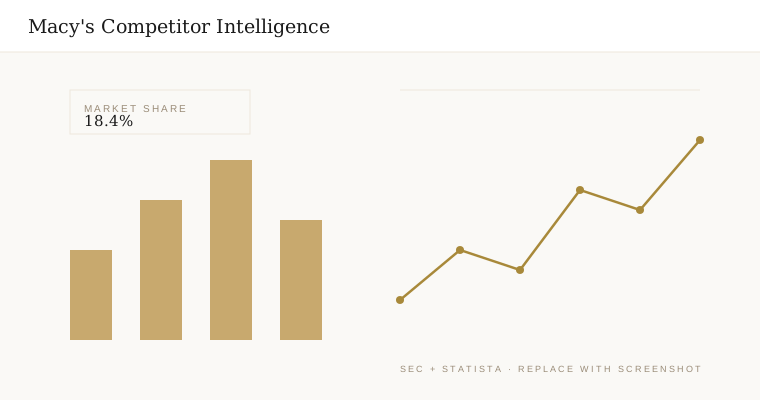
05An interactive Tableau dashboard built on real SEC & Statista data, mapping Macy's against the field.
 06
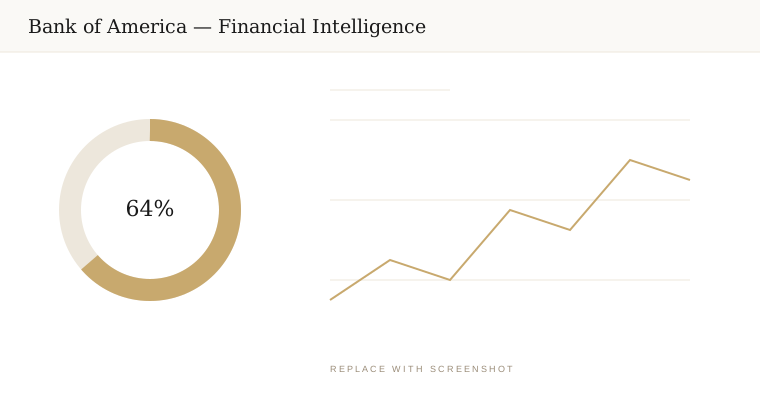
06A financial-intelligence Tableau dashboard distilling performance signals into a single executive view.
Built data-driven sourcing intelligence for a manufacturing marketplace, applying ML to match supply with demand at scale.
Led applied research turning experimental datasets into models and insight, bridging the gap between raw findings and decisions.
Specializing in AI and data science: building multi-agent systems, ML pipelines, and the analytical foundation for the work I want to do next.
Built predictive models and analytics solutions at AI Adventures across multiple client industries, including retail and sports media.
I'm drawn to the problems no one has cracked yet. If that's the kind of work you're doing, let's talk.
If you're working on something ambitious, I want to hear about it.